Golf has never been more popular.
Yet for many Canadians, it has never been harder to simply try the game.
That may sound like a contradiction.
It isn’t.
Courses are full.
Equipment has never been better.
Professional golf is thriving.
Participation is growing.
Yet somewhere along the way, access quietly began to disappear.
The game that once welcomed curiosity has become increasingly difficult to discover.
There was a time when a parent could take their son or daughter to the local golf course and spend an afternoon chipping and putting without spending a dime.
A teenager could ride their bike to the course after school with an old seven iron and a handful of golf balls.
Friends could spend hours on a practice green, inventing games, laughing, competing and learning together.
Many of us fell in love with golf long before we ever played eighteen holes.
We fell in love with possibility.
Today, those simple opportunities are becoming increasingly rare.
Many practice facilities are reserved for golfers with tee times.
Driving ranges are often unavailable unless you are playing that day.
The cost of equipment continues to climb.
Green fees continue to rise.
For many families, introducing a child to golf has become a significant financial commitment before they have even discovered whether they enjoy the game.
Golf isn’t disappearing.
Access to golf is.
That should concern all of us.
Because golf is much more than a game.
It teaches honesty when no one is watching.
Patience when things don’t go our way.
Respect for others.
Perseverance.
Humility.
Personal responsibility.
Unlike most sports, golf allows each of us to chase improvement on our own terms.
You don’t need to make the team.
You don’t wait to be selected.
You don’t depend on a coach deciding whether you’ll get playing time.
You simply play.
You learn.
You come back tomorrow a little better than you were today.
That opportunity changed countless lives.
We all have the memory of how we picked up the game. Picking up golf changed my life for the better, and that of my friend Dave Turner’s.
Dave grew up in rural Canada where imagination mattered more than facilities. Telephone poles became flagsticks. Farmers’ fields became fairways. Old clubs were shared among friends, and every afternoon became another chance to learn.
Eventually those adventures led him to a golf course, then to junior championships, then to a career in landscape architecture and municipal parks.
Years later, after helping communities build countless recreation facilities, he noticed something that had quietly gone unquestioned.
Soccer was represented.
Baseball was represented.
Swimming was represented.
Hockey was represented.
Tennis was represented.
Basketball was represented.
Golf rarely had a seat at the table.
That observation stayed with him.
It made its impression on me as well.
Over the past twenty-five years I have had the privilege of designing some really great golf projects throughout Western Canada.
Putting greens.
Putting courses.
Short courses.
Miniature golf.
Driving ranges.
Natural grass and synthetic turf golf projects of every description.
I have seen first-hand what happens when golf becomes accessible.
Children who have never held a golf club discover a game they will enjoy for the rest of their lives.
Grandparents introduce grandchildren to a sport they can play together.
Neighbours gather.
Conversations begin.
Communities become stronger.
And every time I walk away from one of these projects, I ask myself the same question.
If we build skate parks for skateboarders…
Basketball courts for basketball players…
Ball diamonds for baseball…
Pickleball courts for pickleball…
Bike parks for cyclists…
Splash parks for families…
Why don’t we build places where people can simply discover golf?
Not championship golf.
Community golf.
Golf that belongs to everyone.
Golf Parks.
Public putting courses.
Park Golf.
Short courses.
Natural miniature golf.
Practice greens tucked into neighbourhood parks.
Small places that create big memories.
The remarkable thing is that this isn’t a radical idea.
Around the world, communities have already discovered that golf doesn’t require 150 acres to change someone’s life.
In Scotland, village practice greens have welcomed generations of new golfers.
In Japan, Park Golf has introduced millions of people to an affordable, social version of the game that fits comfortably into community parks.
Here in Canada, Golf Canada has begun championing golf in small spaces, recognizing that the future of the game depends not only on great golf courses, but on welcoming places where people can discover golf for the very first time.
Some Canadian municipalities already understand this.
Others are beginning to explore what community golf can look like.
Many communities, however, still offer nothing at all.
That is an opportunity.
Not because every municipality needs an eighteen-hole golf course.
But because every municipality can find room for a place where a child can hit their very first putt.
Imagine a neighbourhood park with a beautifully designed putting course.
Imagine families gathering after dinner for a friendly competition.
Imagine seniors teaching grandchildren how to read a green.
Imagine school classes learning golf within walking distance of their classroom.
Imagine teenagers choosing to spend an afternoon outdoors rather than indoors.
Imagine a place that is free.
Welcoming.
Beautiful.
Simple.
A place where no one asks whether you belong.
Because everyone does.
Every golfer began somewhere.
Not with a launch monitor.
Not with a membership.
Not with a $700 driver.
Every great golfer began by hitting one golf ball.
One club.
One welcoming place.
Someone believed they belonged.
That is what we must build again.
Because golf doesn’t belong behind gates.
It belongs in our communities.
It belongs in our parks.
It belongs within walking distance of where children live.
It belongs to grandparents introducing grandchildren to a game they love.
It belongs to beginners.
It belongs to families.
It belongs to every community.
Most of all…
It belongs to everyone.
Let’s bring golf back to the people.
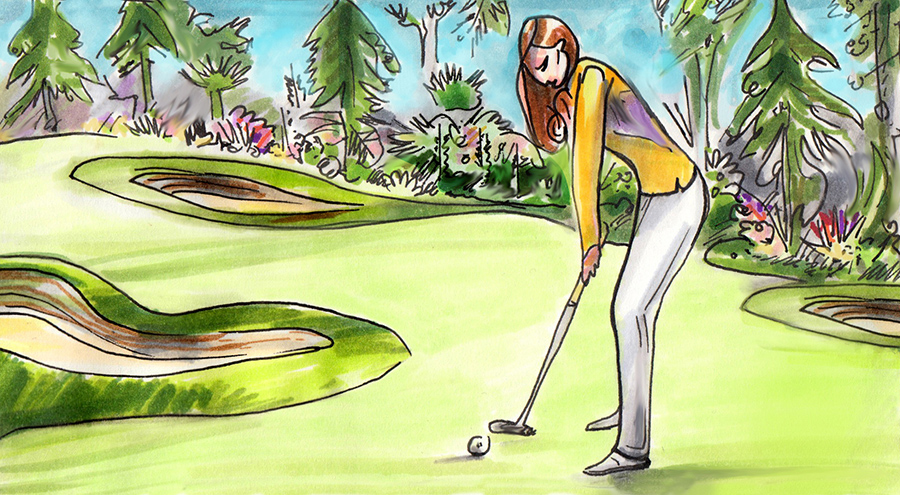
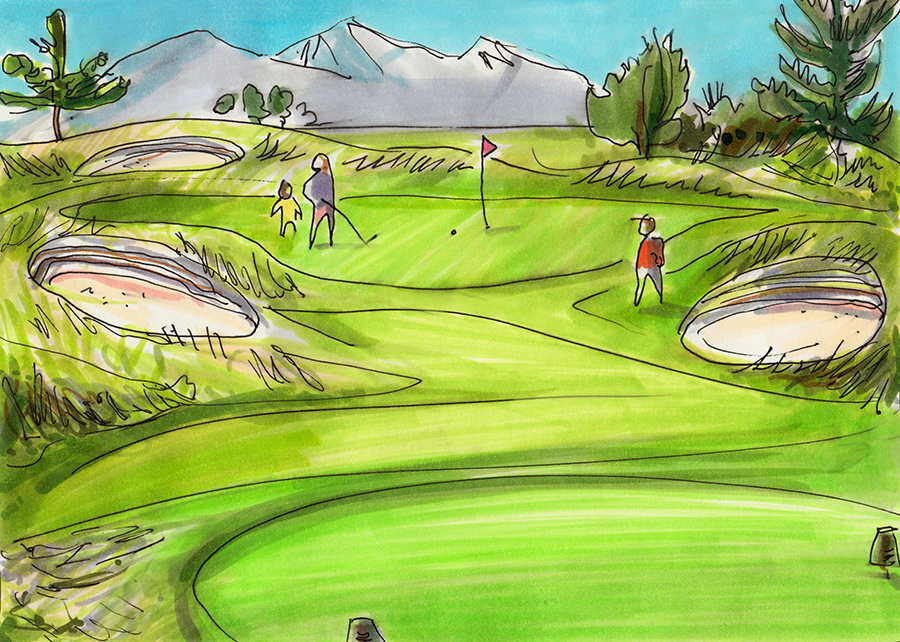
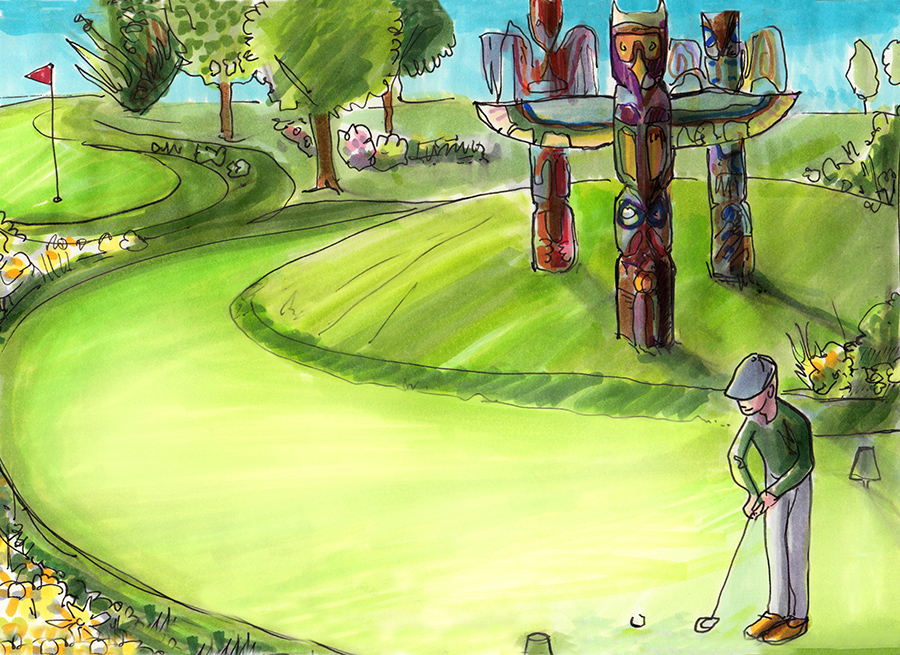
The following are some early concept drawings I had made by local Vancouver artist Peter Winnett when trying to describe my vision for community Golf Parks and Putting Courses